
About RRHARTS
An initiative that started in 2018, and a campus being built now.
Rainbow Ripples Healing Arts is a wellness-informed, land-based Michigan nonprofit initiative in Swartz Creek, developing 11 acres into a connected community campus.
Our story
From an idea to a place
RRHARTS began in 2018. Over the years that followed it grew from an idea into a vision for something place-based — not a program delivered in a rented room, but a piece of land where food access, education, accessible outdoor space and community connection could be built into the same ground.
The Michigan nonprofit corporation was formed in 2026, and Articles of Incorporation were filed and approved on June 29, 2026. The campus sits on 11 acres at 2195 Van Vleet Rd in Swartz Creek, inside Clayton Township, Genesee County.
The full story of why Keith and Lindsay started RRHARTS is theirs to tell, and it will be added here in their own words.
Our mission
What RRHARTS exists to do
Rainbow Ripples Healing Arts is a wellness-informed, land-based community initiative serving underserved residents through community gardens, accessible walking paths, a Veterans Village, an education campus, food access, sustainable living education, horticulture, agriculture, animal husbandry education, outdoor learning, community connection, and related charitable and educational activities.
Growing food. Teaching skills. Creating connection. Building a stronger community from the ground up.
Our vision
A living campus, not a set of buildings
RRHARTS envisions a campus where land becomes a classroom, food becomes a community resource, accessibility is designed in from the beginning, practical skills create greater independence, and people who have too often been pushed to the margins have a place to learn, contribute, connect, and build greater stability.
The long-term goal is not merely to construct buildings. It is to develop an interconnected community ecosystem.
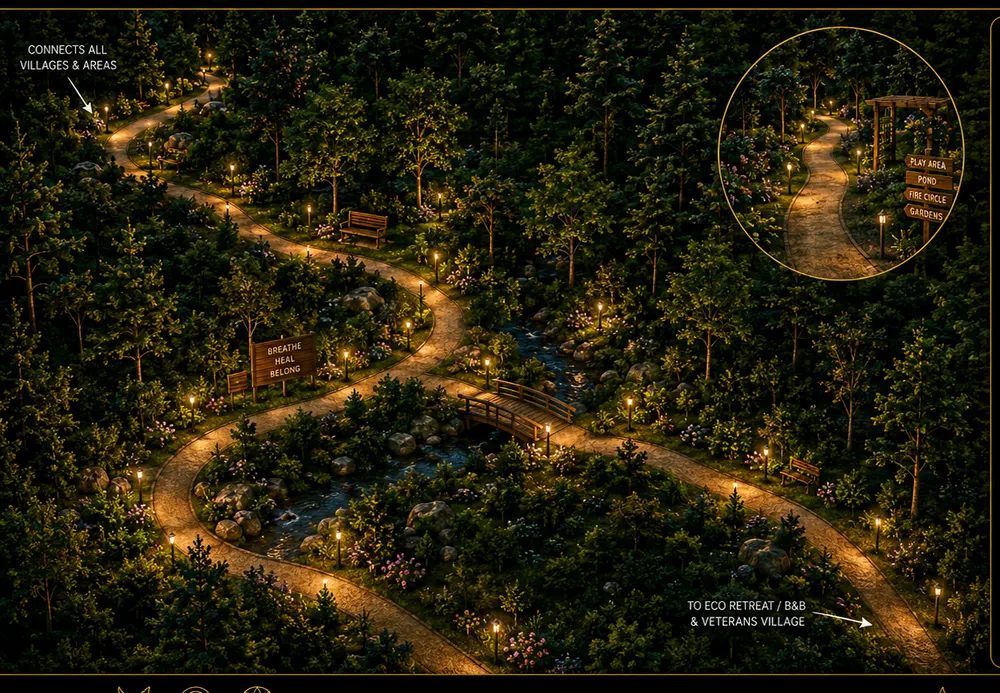
Gardens support food access. Paths connect people and places. Education turns the land into a classroom. Community spaces create belonging. Future village areas create pathways toward stability and dignity. Each component should strengthen the others.
Our values
Five words, and what they cost to mean
- FaithA conviction that a place like this is worth building before it exists.
- HopeThe belief that stability is buildable, not simply hoped for.
- LovePeople are treated as neighbors and contributors, never as cases.
- IntegrityWhat is planned is called planned. What is built is called built.
- HonorRespect for the people this exists to serve, and for what they carry.
Why land-based?
Because the land can do more than hold the buildings
A community garden is food access and a horticulture class at the same time. A walking path is accessible movement, wayfinding and an outdoor classroom at the same time. A greenhouse extends a Michigan season and teaches propagation in the same structure.
Put those systems on separate sites and each one is a project. Put them on one property and they start feeding each other — which is the whole argument for building this on 11 acres rather than in a storefront.
Why community?
Because isolation is usually the actual problem
RRHARTS is being developed to benefit underserved residents and the broader Genesee County community: veterans, families experiencing instability, seniors, residents with disabilities or accessibility needs, food-insecure households, community learners and volunteers.
The emphasis is dignity rather than deficiency. Stability becomes stronger when people are connected to a community rather than separated from one, and a person who can contribute is in a different position from a person who can only receive.
Leadership
Founder and Co-Founder
Advisors and collaborators
These roles describe how each person contributes. Board and officer titles are published only once they match the final signed Board record — an advisor is not a director until the record says so.
- Dr. Joyce PiertEvaluation and outcomes
- Christopher CeaserIT and data systems
- Brian BradfordFinancial advisor
- Rob MeyerAdvisor — science and systems
Biographies, credentials and headshots are pending approval and will be added as leadership confirms them. Nothing on this page is written on anyone's behalf.
Our development journey
Built in phases, described honestly
The fastest way to lose a funder, a township official or a neighbor is to describe a plan as though it were a building. Here is where each part actually stands.
-
Underway
Foundation
- Nonprofit formation
- Governance and Board development
- Site planning and professional review
- Township pathway
- Insurance and compliance preparation
- Partner development and grant readiness
-
Planning
Land & Access
- Entrance, parking and site circulation
- Gardens and food systems
- Greenhouse and high tunnel
- Outdoor learning areas
- Accessible paths
-
Future phase
Education
- Rainbow Community Dome
- Community education
- Sustainable Living Solutions Academy
- Workshops and volunteer programming
- Food access programming
-
Future phase
Village Development
- Veterans Village
- Family Village
- Seniors / Accessible Village
- Housing-related infrastructure
Only after zoning, utilities, code, funding, insurance, resident policies and partner pathways are established.
-
Long term
Long-Term Sustainability
- Expanded food production
- Education replication and publications
- Earned-revenue activities consistent with nonprofit purpose
- Future sustainability and educational retreat area
- Expanded partnerships
Faith, Hope and Love. Integrity and Honor. These Change your Mentality and then it Changes your Reality.